
2027 SRC Programme: Common Security in a Diverging World (PROTECT)
- Funding for multidisciplinary and interdisciplinary projects seeking solutions to the challenges presented in the programme; applications invited from consortia with at least three organisations and at least three research fields
- project budget for first funding period: €2.75–3 million; total project duration 3+3 years
- Solving societal challenges requires not only appropriate research but also interaction aimed at societal impact between researchers and knowledge users throughout the project’s lifecycle. The funded projects are required to participate in SRC programme activities.
The Finnish Government decided the 2027 themes and priorities for strategic research in its plenary session on 15 October 2026. The cross-cutting priority is ‘Data as power’.
This programme focuses on security and psychological crisis resilience. The aim is to understand the social, institutional and cultural mechanisms that influence the experience of safety and to identify means to strengthen society’s ability to act in the midst of change and uncertainty.
The Strategic Research Council (SRC) established within the Research Council of Finland provides funding for long-term, solution-oriented research of a high scientific standard that is aimed at finding solutions to major societal problems and challenges. SRC funding has the following characteristics:
- The funding is only granted to consortia. The consortia must follow the consortium structure required by the SRC.
- The funded consortia form a thematic programme led by a part-time programme director separately funded by the SRC. The main task of the programme director is to promote the societal impact of the programme.
- The activities of the projects and their effects will also be monitored regularly. Certain parts of the monitoring data are public and can be used by the Research Council of Finland in its communications.
- The funded projects shall commit to following the principles of responsible science.
- The funding can be used to cover the salary of the consortium PI for the duration of the funding period. The SRC requires that consortium PIs commit themselves with a sufficient level of input to heading their consortium.
- The consortia should work towards a balanced gender composition.
- The funding follows the full cost model, and the SRC’s funding contribution comes to 100%.
Funded consortia and the programme director shall actively participate in programme activities and cross-programme activities for social impact. Programme directors are responsible for programme-level development of interaction and cross-programme cooperation, and they promote the societal impact of strategic research. The funding for programme directors is granted through a separate call for applications, which is open concurrently with the programme call. A programme director may not act as consortium PI, subproject PI or work package leader in the programme they manage. The programme director must be a researcher at the professor or docent level.
The present SRC call has two stages. The first stage is open to all eligible applicants. SRC consortia shortlisted in the first call stage will be invited to submit full applications. The SRC decides which consortia are invited.
SRC consortium PIs must have a doctoral degree and hold the title of docent or have research experience at the docent level. To be eligible, a consortium must include at least three organisations and at least three research fields. An SRC consortium must also have an interaction coordinator qualified in their own field.
Before you fill in your application in the online services (SARA), carefully read the call text, the RCF's standard terms for funding and the SRC’s funding principles. Also read the section on responsible science available on the Research Council of Finland’s website.
If the call text is in conflict with the standard terms, the terms should always be considered primary. If the translated English or Swedish version of the call text is in conflict with the Finnish call text, the Finnish version should always be considered primary.
Any changes in the call guidelines between the first and the second call stage will be notified on this page.
Read the full call text below.
This programme focuses on security and psychological crisis resilience. The aim is to understand the social, institutional and cultural mechanisms that influence the experience of safety and to identify means to strengthen society’s ability to act in the midst of change and uncertainty.
The programme focuses on psychological security and the functional capacity of the population, which are essential elements of common security. The experience of security is built on a sense of belonging, community and trust. In an increasingly diverging world, demographic changes, regional differences, growing economic uncertainty and global crises, for example, challenge the experience of security and increase the need for a high capacity for adaptability and reform. Increasing inequalities, echo chambers and value conflicts can also weaken the readiness to face threats with common goals. The dynamics of the digital operating environment, rapid technological development and security risks associated with increasingly comprehensive data collection may further increase feelings of insecurity. Key issues include: What sustains trust and the experience of belonging to society in a diverging world? What kinds of social and institutional structures are needed to maintain Finland’s common functional capacity? What could be the significance of culture, arts and broad-based civilisation in building functional capacity?
This programme examines security as a perceived, social and structural phenomenon and analyses the interconnections of these dimensions in a diverging world. Within the programme, it is essential to study factors that strengthen psychological resilience to crises in the context of various threats and disruptions. The research may focus on supporting good demographic conditions and shared agency, on strengthening faith in the future or on creating new opportunities for participation and influence. The importance of shared democratic values and the role of culture and the arts as forces that create a common worldview can contribute to providing relevant perspectives for the theme. In addition, research under this theme can address the construction of economic security at both the individual and the national level. Individual projects can also study the role of the information environment in building trust and a sense of security.
A cross-disciplinary and interactive approach and stakeholder cooperation are of key importance in exploring the societal structures that maintain common security. Networks, partnerships and stakeholder cooperation contribute to Finland’s comprehensive security.
Cross-cutting priority: Data as power.
‘Data as power’ is the cross-cutting priority for the 2027 strategic research programmes.
Data and data quality, in particular data representativeness, transparency, accessibility, compatibility, limitations and opportunities for use, are increasingly determining the direction of research. Data has economic and societal power, which makes data quality particularly important. At the same time, data raises important ethical, legal and societal questions, for example regarding ownership, access rights, privacy and security. The utilisation of data is limited by uneven access and identified blind spots, in particular by the under-representation of socially vulnerable groups in data.
In the 2027 strategic research programmes, these data-related issues will be examined from the perspective of each research topic. In the data they use and the data collection methods, projects must take into account factors that the Finnish scientific community can use more widely in future. These data-related issues and solutions must be clearly described in the project plan.
Programme’s impact objectives
The programme strengthens the security and crisis resilience of Finnish society by producing information on factors affecting psychological security and the functional capacity of the population. The aim is to identify and develop concrete ways to strengthen society’s ability to act in the midst of change and uncertainty.
Programme questions:
A. On which challenges defined in the programme will the project be focused, and what kind of combination will they form?
B. How will the proposed research and interaction contribute to a cross-disciplinary understanding of the research topic?
C. How will the proposed research and interaction create concrete conditions for solving the challenges presented?
D. What concrete societal impacts is the project aiming to achieve, and which societal actors are seen as the main beneficiaries of the research?
E. How will ‘Data as power’ be integrated as a cross-cutting priority into the research and interaction of the entire consortium, starting from project planning and target setting?
Strategic research funding may only be applied for by consortia. The consortia funded by the Strategic Research Council – SRC consortia – are structurally different from consortia funded by the Research Council of Finland under the Academy Project and Academy Programme funding schemes. The research and interaction activities are distributed appropriately between work packages (WPs).
Each consortium must have a PI, WP leaders and an interaction coordinator. In the full application, each subproject must have a named subproject PI at the site of research, who is responsible for the subproject’s use of funding and for submitting the application.
PIs and WP leaders of SRC consortia must have a doctoral degree and hold the title of docent, or research experience at the docent level. The interaction coordinator must be qualified in their own field, but they are not required to have a doctoral degree.
Read more: SRC consortium guidelines.
An example of a possible structure for an SRC consortium:
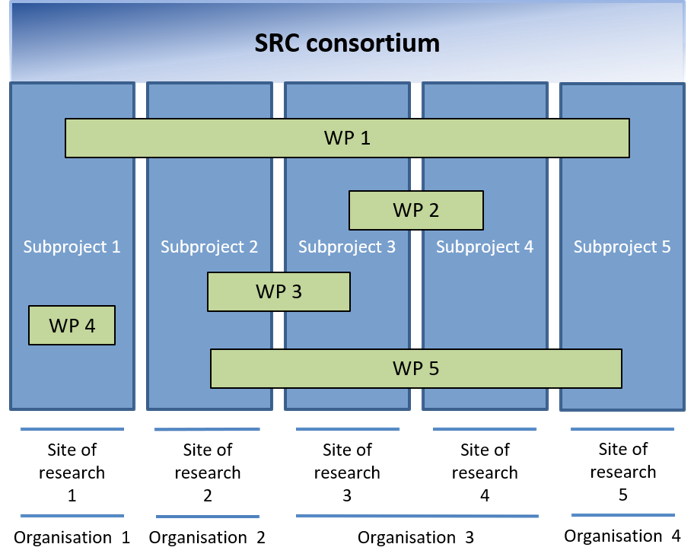
SRC consortia must be based on multidisciplinary collaboration. The research work must not rely too heavily on a single site of research, research team or scientific discipline. This will require sufficient resources for managing and coordinating the consortium, for carrying out the consortium's interaction activities and for cross-programme activities for societal impact. The consortia should work towards a balanced gender composition.
A subproject PI must be competent to lead the subproject. As a rule, they also should hold a doctoral degree. An exception to this doctoral degree requirement is a subproject led by an interaction coordinator.
The SRC’s funding for strategic research benefits the scientific community in Finland as well as Finnish society at large. The site of research of the subprojects is a Finnish organisation (usually a university or research institute) via which the funding is paid. Typically, strategic research themes are topical and important also outside Finland.
The SRC encourages applicants to plan international cooperation to promote understanding and societal solutions based on the best scientific knowledge in Finland. Under new SRC programmes, funding will no longer be granted for projects to be carried at foreign sites of research. However, Finnish sites can apply for funding for international cooperation and mobility in SRC projects in accordance with the Research Council of Finland’s standard terms for funding.
According to the RCF’s general terms and guidelines, the funding cannot be used for economic activity. Economic activity is defined as all activity where goods or services are offered on an open market regardless of whether profits are pursued or generated. If the funding is applied for by an organisation other than a university, a university of applied sciences or a research institute, the applicant must confirm their eligibility and the funding conditions from the programme’s contact person in good time before submitting the application. Failure to do so will jeopardise the processing of the entire consortium application.
The consortium PI is responsible for ensuring that the consortium parties are eligible to apply for and receive funding.
The PI of the application cannot be changed while the application is being processed (after the call has closed but before the decision). The only exception to this is if the PI dies.
Restrictions
PIs of SRC consortia can act as PIs only in one consortium funded by the SRC. Consortium PIs of the SRC programmes ending in 2027 (DEMOGRAPHY and BIOD) are eligible to apply in this call, since the funding periods would not overlap or the overlaps would only be minor.
The same person may serve in a leadership role, or in multiple leadership roles, in only one application across the two SRC programme calls currently open for application. The following are considered leadership roles in an SRC consortium: consortium PI, subproject PI and WP leader. In other words, an application can only be submitted to one SRC call and the applicant can only hold such positions in one application. Consortium PIs must check the eligibility of these persons. If a person holds one of the roles mentioned above in more than one application, we will only consider (process) the first application submitted in the online services.
As the SRC consortia are expansive, leading one requires a considerable amount of work. The SRC requires that consortium PIs commit themselves with a sufficient level of input to heading the consortium. Directors of the Research Council of Finland’s Centres of Excellence cannot therefore act as PIs for SRC consortia.
SRC consortium directors or WP leaders named in the letter of intent may be changed between the first and second call stage only for very compelling reasons. The contents of the research and interaction plan must remain essentially unchanged. Consortium parties cannot be removed.
Any changes to consortium compositions made for the above reasons must be justified in the research and interaction plan of the full application. In addition, in such cases, applicants must get in touch with the programme’s contact person before they submit their full application.
Conditions and obstacles to the granting of funding
Funding may only be granted if the conditions laid down for the granting are met and if there is no obstacle to the granting. Provisions on the general conditions and obstacles to the granting of government grants are laid down in the Finnish Act on Discretionary Government Grants (688/2001). In addition, the funding is granted subject to the specific conditions and restrictions concerning RCF funding and the call in question.
The conditions and obstacles to granting apply to all consortium subprojects. If a condition is not met or an obstacle arises, the entire consortium application is declared inadmissible or is rejected.
The application or consortium application is declared inadmissible or rejected in the following cases:
- The application is late.
- The application is substantially incomplete, or the application has not been supplemented as requested by the deadline. The RCF will request supplementation if the incompleteness can be corrected so that the application can be considered. However, the possibility of supplementation does not apply to research or action plans. An application may be dismissed without a request for supplementation if the incompleteness cannot be corrected by providing additional information.
- The site of research does not commit to the application by the deadline.
- The applicant is not eligible. Eligibility is defined in this call text.
- The applicant has submitted more than one application in the call. In that case, only the first application will be considered.
- The applicant has been found guilty of a serious violation of research integrity within the past three years.
- The applicant has not submitted a report on a completed or ongoing RCF- or SRC-funded project according to the guidelines and by the deadline.
- The applicant is a member of the Board of the RCF, one of its scientific councils or the Strategic Research Council (SRC) during the period in which the call or funding decision process is being conducted. Furthermore, the application will not be considered if a member of the above-mentioned bodies is a work package leader in the SRC consortium.
- The applicant has participated in the planning of the call to an extent likely to give them a comparative advantage over other applicants.
- In the application, the applicant has not identified and assessed the risks related to research security as instructed and, where necessary, has not presented an adequate risk management plan.
- The applicant has not described in the application, in accordance with the guidelines, how good scientific practice will be followed in the implementation of the project.
- The applicant has not described in the application, in accordance with the guidelines, how gender equality and nondiscrimination will be promoted in the implementation of the project.
- The applicant has not described in the application, in accordance with the guidelines, how the project complies with RCF guidelines on the implementation of open access to research outputs and, in the case of research data, on responsible data management.
- The funding has been applied for to a site of research that is not located in Finland, or the applicant does not have a close connection to Finland to implement a multi-year project.
- The funding has been applied for in such a way that the final beneficiary is an organisation located in Russia or Belarus, or that cooperation with Russian or Belarusian researchers or research teams violates the instructions or regulations of the site of research or the authorities. The funding shall be granted and used in a way that respects the equal treatment of researchers regardless of nationality.
- The applicant or the application does not meet the competence or other key requirements set for the call, the application does not belong to the call in question, there are in some other respects no conditions for processing the case, or it is apparent that the applicant for some other reason cannot receive funding with the submitted application.
The RCF Board decides the principles for RCF funding decisions, that is, the guidelines that outline the special conditions and other criteria for the RCF's funding decisions. The SRC decides its own funding principles. This present call is governed by the principles for RCF funding decisions adopted on 18 September 2025 and by the SRC funding principles adopted on 27 October 2025.
If, after the application has been submitted, funding is received for the same purpose from another call or from another funder, notify the RCF of this without delay.
The project duration in the programme is six years. The research and interaction plan included in the application must be drafted to cover the entire six-year period. However, the funding will be granted in two parts (3 + 3 years).
The funding is granted to a Finnish site of research (usually a university or institute institute) through which the funding is paid. The consortium PI must have a close connection with Finland to support the implementation of a multi-year project. The funded researchers may, however, spend time working abroad during their funding period.
In the two programmes open for application (PROTECT and RESOURCES), the SRC is prepared to fund 8–9 projects with 2.75–3 million euros each during the first funding period. The total funding budget for the first three years has been set at 24 million euros. The cost estimates of the projects must be realistic. The funding to be distributed through this call depends on the Finnish Parliament’s decision to allocate the necessary funds in the 2027 state budget.
The first funding decision will cover the period 1 October 2027–30 September 2030. The progress of the projects will be reviewed at the end of the first funding period, and a possible second period will be granted for 1 October 2030–30 September 2033. It is not possible to transfer funding from one funding period to another. The cost estimate for an SRC consortium’s six-year term must be drafted so that the funding for the second funding period comes to no more than 100% of the funding for the first period.
The applicant shall present a funding plan drafted according to the full cost model. In SRC projects, the Research Council of Finland’s funding contribution to the research costs is 100%. Read more: Full cost model.
Salaries
The SRC requires that consortium PIs commit themselves with a sufficient level of input to heading the consortium. Funding granted by the SRC can be used to cover the salary of consortium PIs for the duration of the funding period. However, the salary funding must not overlap with salary paid from funding by the Research Council of Finland.
Staff to be hired with SRC funding must have an employment relationship with their site of research. With regard to research personnel, the funding is primarily intended for the salaries of researchers with doctoral degrees.
As a rule, staff hired with SRC funding must be in an employment relationship to their site of research. We recommend that they be hired for a period of employment no shorter than the funding period, unless a shorter contract is necessary for special reasons dictated by the implementation of the research project. Short-term research, study, or other assignments may also be carried out in the form of outsourced services, the duration of which, as a general rule, shall not exceed six months.
Other eligible costs
SRC funding is granted for research and related interaction activities. In SRC calls, funding can be applied for to cover the salary and other costs arising from the implementation of the research and interaction plans.
Other eligible costs include the following:
- costs of implementing the interaction plan
- cross-programme activities for societal impact
- research costs
- travel expenses
- costs of collaboration and mobility in Finland and abroad (of key significance to the goals of the project)
- costs of preparing international projects
- auditing costs.
SRC funding cannot be used to pay for acquisition of significant infrastructures.
All acquisitions must be made in accordance with the Finnish Act on Public Contracts. Where necessary, the acquisitions must be put out to tender in compliance with the practices stipulated in the Act.
SRC funding cannot be used for economic activity. Read more: Economic operator.
Funding plan
In the letter of intent, the consortium PI shall present the cost estimate for the first funding period as estimated total costs (all subprojects combined) per year. The estimate is entered in the online services on the tab ‘Funding for the project’ under ‘Other costs’. Thus, the types of expenditure should not be itemised (salaries, indirect costs, overheads, travel, etc.). The cost estimate must be realistic.
In the full application, each subproject will draft its own cost estimate, itemised by type of expenditure.
The full application must include (under the tab ‘Funding for the project’) a cost estimate for the first funding period, showing an estimate of the annual amount of funding needed by the SRC consortium. The cost estimate must be realistic. Changes in the funding plan’s total costs between the letter of intent stage and the full application stage will only be approved in exceptional cases.
The cost estimate must be justified in the full application’s research and interaction plan, which also includes a cost estimate for the entire duration of the project (first and second funding period). The cost estimate for the entire project is drawn up so that the costs of the second funding period may come to no more than 100% of the cost estimate for the first period.
In the full application, all research costs must be justified in the free-text field in the online services on the tab ‘Funding for the project’.
Account of salary when PI does not have an employment relationship
If the PI does not have an employment relationship with, for example, a university or research institute for the duration of the funding period, they must explain in the free-text fields (the tab ‘Funding for the project’) how their salary will be covered during the funding period. Retired researchers can be granted funding on the same grounds as other researchers.
Mobility aid in research projects
The researcher mobility carried out in SRC-funded projects must be goal-oriented. It should support project implementation, reinforce the international networks of the researchers involved, and create new knowledge and know-how. Mobility plans are not necessary in the letters of intent. In the full application, the applicant must enter their subproject’s mobility plan on the application form in the online services.
Mobility aid is applied for as research costs related to the implementation of the research plan. The aid is applied for in accordance with the practices of the site of research. To obtain further information, contact the personnel and financial administration of the site of research.
In the online services, the aid is applied for on the tab ‘Funding for the project’ under ‘Travel expenses’. The mobility aid must be justified. Read more about the mobility aid in the standard terms for funding.
What is required from the site of research?
The site of research is a Finnish research organisation such as a university, a research institute or some other research organisation.
We require that the site of research provides the research project with all necessary basic facilities. These are determined based on the nature of the research and are the same as those available to other research staff at the site: office and laboratory premises, equipment (incl. computer equipment), and telecommunications, telephone, mailing, copying and library services.
The costs of ensuring immediate open access to peer-reviewed articles are included in the overheads of the site of research. The costs associated with storing and sharing research data and material are regarded as overheads for the project’s site of research. They may only exceptionally and for justified reasons be accepted as research costs to be covered with RCF research funding. The site of research also commits to ensuring that the data management plan can be implemented at the site of research, and that the measures to be taken comply with good data management practice. After a positive funding decision, the site of research will also approve the data management plan of the project.
When accepting the funding, the site of research is responsible for ensuring that necessary statements and permits from ethics committees have been obtained as appropriate. The site of research shall also make sure that the applicant has not been found guilty of any serious violation of research integrity during the previous three years.
The overheads, indirect employee costs and coefficient for effective working hours of the site of research are also entered in the application. The site of research maintains these percentages in the online services under the site’s details. The information is provided as percentages.
When the site of research is a university or research institute, as a rule, the funding is applied for VAT included. Consult the financial administration at the site of research for more information. The funding may cover VAT costs, but only on certain conditions (see Value added tax, and read more in the standard terms for funding).
How to submit and supplement the application
The deadline is non-negotiable. We will not consider (process) an application that has not been submitted by deadline. The first call stage (letters of intent) closes on 15 December 2026 at 23.59 Finnish time. The second call stage (full applications) closes on 14 April 2027 at 23.59 Finnish time. Applications submitted in paper form must arrive by the closing date at 16.15.
The joint letter of intent for the SRC consortium is submitted only by the PI.
The joint full application for the SRC consortium is submitted by the consortium PI. They can submit the consortium application only after all subprojects have marked their applications as complete.
Call guidance (see section ‘Contacts’) will be available until 16.15 (Finnish time) on the closing date of the call. If you run into problems in the online services that prevent you from submitting the application, please contact the RCF Registrar's Office by email at kirjaamo@aka.fi before the deadline. In this case, the RCF will decide on a case-by-case basis how the application will be considered. Start drafting the application early enough so that you have time to contact us in case any issues arise.
It is the responsibility of the applicant to submit the application before the deadline expires. The applicant is responsible for ensuring that the application contains all mandatory information and appendices and that they comply with the requirements set out in the instructions.
You can edit and supplement the application until the deadline. For example, you can change the appendices to the application. If you notice that your application lacks important information after the deadline, immediately get in touch with us via our helpdesk, so that the application can be reopened for supplementation. However, the possibility of supplementation does not apply to the research and interaction plan. Once the review process has started, supplementations can no longer be taken into account. Typically, the application review begins 1–2 weeks after the call has closed.
We may ask you to supplement the application. In that case, you will receive a supplementation request by email. If you do not supplement the application by the given deadline, or if the application is substantially incomplete even after a request for supplementary information, we may declare it inadmissible (i.e. it will not be processed). Make sure that your email address is up to date.
How the application becomes pending
According to section 17 of the Finnish Administrative Procedure Act and section 8 of the Act on Electronic Services and Communication in the Public Sector, the sender is responsible for the application arriving by the set deadline. An application becomes pending when the online application and the obligatory appendices have been submitted in the online services. The system will confirm a successful submission by sending an email to the address you have provided.
Publicity and data protection
The RCF is committed to following regulations on data protection and openness. Except for research plans, plans of intent, abstracts and progress reports, which are primarily kept secret, the application and its appendices are public documents. For example, the CV is a public document and as such must not include any non-disclosable information. Other parts of the application may also contain non-disclosable information. This publicity is based on the Finnish Act on the Openness of Government Activities.
Applications and decisions also contain personal data, so their processing is also subject to data protection legislation, in particular the EU General Data Protection Regulation and Finnish Data Protection Act. The applicant is responsible for the disclosure of any personal data contained in the application and, where appropriate, for requesting the consent of the parties concerned.
The GDPR-compliant privacy notice concerning the informing of data subjects is available on our website under Data protection.
The letter of intent submitted at the first call stage consists of forms completed in the online services as well as PDF appendices. As an applicant, you have the right to submit your application in Finnish or Swedish, but we ask that you to submit it in English to facilitate the international review.
The SRC consortium PI is responsible for drafting and submitting the letter of intent in the online services. To minimise the administrative burden on the process, the letter of intent is drafted as an individual application. Consortium PIs must check the eligibility of each WP leader and that they are participating in only one application per SRC programme. The WP leaders and interaction coordinators must be named in the application.
Please note that only consortia invited to the second call stage are required to include a research security assessment with their application. Funding can only be granted if the applicant has identified and assessed the risks related to research security and, if necessary, presented an appropriate risk management plan. See the template and learn more about research security.
Most of the links below take you to the A–Z index of application guidelines.
The letter of intent submitted in the online services (SARA) consists of the following parts
Personal data
- Personal details
- Degrees (most recent one first); parental leaves etc. may be filled in under ‘Additional information’.
- Titles of docent and professorships
CV and list of publications
- Drafted on a template, submitted as a PDF appendix (read more about the structure)
- Maximum length three pages (CV 2 pages, list of publications 1 page)
- The list of publications contains the ten most project-relevant publications by the applicant.
General information
- Details on the site of research
- Title of research project in English and Finnish/Swedish
- Research fields (at least three, no more than five). See the research field classification.
- Keywords in English and Finnish/Swedish
Abstract
- Maximum length 2,500 characters including spaces
- Brief overview of scientific and societal objectives, research methods and data as well as expected research results and impact
- Read more: Abstract
SRC consortium composition
- Information on the WP leaders and interaction coordinator (name, email, organisation and country)
- Choose the person’s role from the drop-down menu. In the case of WP leaders, add the WP number in the accompanying text field.
- A WP may have only one leader.
- Read more: SRC consortium applications.
Plan of intent
- Maximum length 6 pages
- Submit the research plan as a PDF appendix on a separate tab in the online services.
- Use the template to draft the plan of intent. You must follow the given structure. Please use the headings provided.
- The application cannot be submitted if the system detects an error in the page configuration or the structure.
- Read more: How-to guides for the online services.
Most relevant publications and other key outputs
- The consortium PI enters a total of up to ten jointly agreed most project-relevant publications by the consortium members (incl. consortium PI) and a total of up to ten of the consortium members’ most relevant own research outputs, with justifications.
- Search for publications in the VIRTA publication information service. Read more: How-to guides for the online services.
- There are separate fields for selected publications and other research outputs. If the desired output type is not listed, select ‘Other, what?’ and enter the name of the output.
- Publications can also be entered directly. Obligatory information: author(s), title, year of publication, name of series/journal, type of publication (will not show in the PDF version of the application).
- The information is used to assess the competence of the applicant or consortium to carry out the project.
Research ethics
- Preliminary ethical review for project and/or animal testing permit (yes/no)
- Found guilty of violation of research integrity (yes/no). We will not consider (process) a funding application if the applicant has been found guilty of a serious violation of research integrity in the previous three years.
- Guilty of illegal employment within the meaning referred to in section 7(2) of the Act on Discretionary Government Grants (yes/no)
- The research-ethical issues are described in the research plan as part of the implementation.
- Read more: Good scientific practice and research ethics.
Funding for the project
- The project’s funding follows the full cost model. The Research Council of Finland’s funding contribution to the research costs comes to 100%.
- Enter the funding period as it is given in the call text (1 Oct 2027–30 Sep 2030).
- In the first call stage, the estimated total costs of the project are entered only as an annual total (incl. all costs of all subprojects, incl. salaries) under ‘Other costs’.
- The estimate must be realistic and based on the implementation of the research and interaction plan. Changes in the cost estimate between the letter of intent stage and the full application stage will only be approved in exceptional cases.
- The commitment must be given within 14 days of the call's closing date, or the application may be inadmissible. Make sure you have a commitment from your site of research (usually a university or research institute) to supporting the project. Read more: Commitment by site of research.
- The consortium PI is responsible for ensuring that all consortium parties are eligible to apply for and receive funding.
Public project description
- Maximum length 1,000 characters including spaces
- Popular and reader-friendly description of the research project in English and Finnish/Swedish
- We will use the project description in our communication about the research project. It is important that the public description is written for a general audience. The project description is also stored at research.fi, a service that makes available information on research conducted in Finland.
- Read more: Public project description.
Authorisation
- You can authorise another person to edit parts of the application for you or to view the application.
- Start by entering the person’s name in the field.
- The person must have an account in our online services (SARA).
- You cannot authorise more than one person at a time to edit a field in your application, and you cannot edit that same field while the authorisation is active.
- Do not authorise yourself.
- See technical instructions on the authorisation process in the how-to guides for the online services.
Appendices
Append only the requested appendices to the application and make sure to draft them in line with our guidelines (use the templates). Also make sure not to exceed the maximum lengths indicated in the call text. Please name each document clearly as this will make the reviewers’ work easier. Draft the appendices in English and append them to the application in PDF format.
Obligatory appendices:
- CVs and lists of publications of WP leaders and interaction coordinator by person, drafted on SRC template. The template contains a CV section (2 pages) and a list of the person’s ten most project-relevant publications (1 page). The list shall be appended only once for each person. Do not combine CVs and lists of publications of several persons into a single file.
Submit application
- You can submit the application when you have filled in or attached all the necessary information.
- A red warning triangle on the tab tells you that some information is missing.
- You can supplement and edit the application until the deadline. Resaving will replace the earlier version.
The full application submitted at the second call stage consists of forms completed in the Research Council of Finland’s online services as well as PDF appendices. As an applicant, you have the right to submit your application in Finnish or Swedish, but we ask that you to submit it in English to facilitate the international review.
The second stage of the SRC call, for full applications, opens in the online services in February 2027. The second stage is open to invited applicants only and closes on 14 April 2027 at 23.59 Finnish time. Applications submitted in paper form must arrive by 14 April 2027 at 16.15. The deadline is non-negotiable.
Full applications for SRC funding are drafted as consortium applications. The applications and appendices of consortium subprojects will be joined together with the consortium PI’s application. The consortium application can be submitted only after all subprojects have marked their applications as complete. Consortium PIs must follow the completion of the application in the online services to make sure that it can be submitted on time.
The application submitted by the consortium PI must include the details, abstract and public description for the PI’s own subproject as well as the whole consortium’s joint research and interaction plan and the CVs and lists of publications for the WP leaders and interaction coordinator (if they are not subproject PIs).
The subproject PIs will complete their own applications, filling in their own subproject’s cost estimate and funding plan as well as all other required fields.
Most of the links below take you to the A–Z index of application guidelines.
The full application submitted in the online services (SARA) consists of the following parts
Personal data
- Personal details
- Degrees (most recent one first); parental leaves etc. may be filled in under ‘Additional information’.
- Titles of docent and professorships
CV and list of publications
- Drafted on a template, submitted as a PDF appendix (read more about the structure)
- Maximum length three pages (CV 2 pages, list of publications 1 page)
- The list of publications contains the ten most project-relevant publications by the applicant.
Consortium parties
- Subproject PIs (site of research receiving the funding)
- Details on each party (name, email address, organisation and country)
- The subprojects PIs must have an account in the Research Council of Finland’s online services (SARA) so that they can be entered as parties to the consortium.
- Read more: SRC consortium guidelines.
SRC consortium composition
- Information on the WP leaders and interaction coordinator (name, email, organisation and country)
- These persons must be the same as in the letter of intent stage. They may be changed only for exceptional reasons.
- Choose the person’s role from the drop-down menu. In the case of WP leaders, add the WP number in the accompanying text field.
- A WP may have only one leader.
- Read more: SRC consortium guidelines.
General information
- Details on the site of research
- Title of research project in English and Finnish/Swedish
- Research fields (at least three, no more than five). See the research field classification.
- Keywords in English and Finnish/Swedish
Abstract
- Maximum length 2,500 characters including spaces
- Brief overview of scientific and societal objectives, research methods and data as well as expected research results and impact
- Read more: Abstract
Research teams
- Project members and their tasks (only persons who are paid salary from the project)
- Team members’ effective working hours (in relation to the funding period concerned)
Research and interaction plan
- Maximum length 19 pages
- Submit the research plan as a PDF appendix on a separate tab in the online services.
- Use the template to draft the plan. You must follow the given structure. Please use the headings provided.
- The application cannot be submitted if the system detects an error in the page configuration or the structure.
- Read more: How-to guides for the online services.
Most relevant publications and other key outputs
- The consortium PI enters a total of up to ten jointly agreed most project-relevant publications by the consortium members (incl. consortium PI) and a total of up to ten of the consortium members’ most relevant own research outputs, with justifications.
- Search for publications in the VIRTA publication information service. Read more: How-to guides for the online services.
- There are separate fields for selected publications and other research outputs. If the desired output type is not listed, select ‘Other, what?’ and enter the name of the output.
- Publications can also be entered directly. Obligatory information: author(s), title, year of publication, name of series/journal, type of publication (will not show in the PDF version of the application).
- The information is used to assess the competence of the applicant or consortium to carry out the project.
Collaborators
- Specify the key collaborators of the project (name, organisation, country, brief description goals/benefits of the collaboration)
- We recommend that the 3–7 most important letters of collaboration relating to the project be attached to the application. Read more about the letter.
- As the applications are reviewed by international experts, we recommended that you write the letters of collaboration in English.
Mobility
- Enter information on planned national and international mobility within the project, itemised by person.
- Read more: Mobility.
- We recommend that the application be accompanied by letters of collaboration from national and international collaborators that are relevant to the project. Read more about the letter.
- As the applications are reviewed by international experts, we recommended that you write the letters of collaboration in English.
Affiliations
- Affiliation with research infrastructures, Centres of Excellence and Finnish Flagships
Research ethics
- Preliminary ethical review for project and/or animal testing permit (yes/no)
- Guilty of violation of research integrity (yes/no). We will not consider (process) a funding application if the applicant has been found guilty of a serious violation of research integrity in the previous three years.
- Guilty of illegal employment within the meaning referred to in section 7(2) of the Act on Discretionary Government Grants (yes/no)
- The research ethics description is entered under section 3 of the research plan.
- Read more: Good scientific practice and research ethics.
Funding for the project
- The project’s funding follows the full cost model. The Research Council of Finland’s funding contribution to the research costs comes to 100%.
- Before you can fill in the cost estimate, you must first select the site of research on the tab ‘General information’.
- The site of research maintains the following percentages: effective working hours, indirect employee costs, overheads percentage and value added tax (VAT). The information is provided as percentages.
- Enter the funding period (1 Oct 2027–30 Sep 2030).
- Enter salaries and other costs.
- Justify the funding to be applied for in the free-text field. The cost estimate must be realistic. Changes in the total sum of the funding plan between the letter of intent stage and the full application stage will only be approved in exceptional cases.
- If the PI does not have a permanent employment relationship for the duration of the funding period, include in the free-text field a salary plan for the PI covering the entire funding period.
- Consult the administration at your site of research when filling in budget details. Read more about the funding in the call text under ‘Funding to be applied for and funding period’.
- The commitment must be given within 14 days of the call's closing date, or the application may be inadmissible. Make sure you have a commitment from your site of research (usually a university or research institute) to supporting the project. Read more: Commitment by site of research.
- The consortium PI is responsible for ensuring that all consortium parties are eligible to apply for and receive funding.
Public project description
- Maximum length 1,000 characters including spaces
- Popular and reader-friendly description of the research project in English and Finnish/Swedish
- We will use the project description in our communication about the research project. It is important that the public description is written for a general audience. The project description is also stored at fi, a service that makes available information on research conducted in Finland.
- Read more: Public project description.
Authorisation
- You can authorise another person to edit parts of the application for you or to view the application.
- Start by entering the person’s name in the field.
- The person must have an account in our online services (SARA).
- You cannot authorise more than one person at a time to edit a field in your application, and you cannot edit that same field while the authorisation is active.
- Do not authorise yourself.
- See technical instructions on the authorisation process in the how-to guides for the online services.
Appendices
Append only the requested appendices to the application and make sure to draft them in line with our guidelines. Also make sure not to exceed the maximum lengths indicated in the call text. Please name each document clearly as this will make the reviewers’ work easier. Draft the appendices in English and append them to the application in PDF format under ‘Appendices’. Only one CV and list of publications should be submitted for each person, even if they hold several positions in the consortium.
Obligatory appendices:
Consortium PI:
- Research security assessment. Use only the given template and read more about research security.
- CVs and lists of publications of WP leaders and interaction coordinator, if they are not subproject PIs, drafted on SRC template. The template contains a CV section and a list of the person’s ten most project-relevant publications. For each person, the list shall be appended only once. Do not combine the CVs and publication lists of several persons into a single file.
Case-specific appendices:
Consortium and/or subproject PI
- Letter of collaboration (‘Collaborators’ and ‘Mobility’). Read more about the letter.
- Account of state aid received (organisations engaged in economic activity); the applicant is responsible for submitting the account in the online services
Submit application
- You can submit the application when you have filled in or attached all the necessary information.
- The joint consortium application is submitted by the consortium PI. They can submit the consortium application only after all subprojects have marked their applications as complete.
- A red warning triangle on the tab tells you that some information is missing.
- You can supplement the application until the deadline. Resaving will replace the earlier version.
The SRC’s funding decisions are based on a review of the merits of the research and interaction plan and the applicant. The review puts particular emphasis on the added value generated by the consortium for the attainment of the objectives set for the programme concerned.
The fundamental principles of the review are transparency, integrity, equity, competence and diversity. Read more: Responsible researcher evaluation.
The letters of intent will be peer-reviewed by a panel composed of Finnish and foreign experts in science and societal relevance. The review will focus on the following aspects:
- compatibility with the programme call
- scientific quality, incl. quality of multidisciplinary collaboration and interdisciplinary research
- societal relevance, interaction and impact.
The applications must have high societal impact and be of a high scientific standard.
The panel will review the letters of intent focusing on the following questions:
Strategic research programme call: letter of intent review questions/Guiding questions
- Does the proposed research match the programme? How significant is it for the programme’s impact aims?
- How plausible is the project’s expected contribution to achieving the solutions pursued by the programme?
- How well does the research plan promote responsible science (research ethics, equality and nondiscrimination, open science, sustainable development)?
- Are the research idea and the initial description of research questions, materials and applied methodologies feasible and do they aim at scientific excellence?
- How does the research plan support inter- or transdisciplinary approach, including integration or transformation of disciplinary perspectives, and what added value does the chosen approach bring?
- Is the consortium competent to execute the plan?
- Are the plans for societal interaction and impact pathways (goals, means, stakeholders and implementation) feasible, and do they aim at concrete steps towards improving policy or practice?
The panel will review all letters of intent assigned to it and issue a written (confidential) review on each application, based on the draft reviews and the panel discussion. The panel will use the review scale of the letter of intent stage, but it will not give ratings. Instead, the panel will divide the letters of intent into three groups (A–C) according to how strongly it recommends that the application be invited to the second call stage. See the review questions and tables: Guidelines and forms for reviewers.
The SRC will decide which consortia are invited to the second call stage based on the panel’s review reports and at its own discretion. Successful consortia will be asked to submit full applications.
The full applications will be peer-reviewed by two panels. The societal relevance and impact and scientific quality of the applications will be reviewed separately. Both panels will use their own review scales in rating (1–6) the applications. Both panels draft one review report on each application. The review report is confidential.
The relevance panel composed of Finnish and foreign experts will review the project for its societal relevance and impact.
The international scientific panel will review the scientific quality of the proposed projects and research plans and the grounds for the research choices.
The SRC will select the projects to be funded based the reviews of the relevance panel and the scientific panel.
See the review questions and scales with descriptions (relevance panel and scientific panel): Guidelines and forms for reviewers.
The research security appendix will not be reviewed.
For justified reasons, we may decide not to review or process an application. The reasons that are considered in these cases are presented under Review and decision-making.
We recommend that applicants familiarise themselves with the review questions (1st and 2nd stages). The review guidelines and forms are only available in English.
The SRC uses the review panels’ assessments of the scientific quality and societal relevance of the applications as criteria for selecting the projects to be funded. In addition, the selection takes into account aspects related to the formation of the programme package as well as any other objectives mentioned in the call text. If there are applications of equal merit, priority shall be given to the application that the SRC considers best advances the dismantling of gender stereotypes, promotes diversity and supports sustainable development.
The decisions on the letters of intent will be made in February 2027 (tentative schedule). Those selected to the second stage will be asked to submit full applications in the online services by 14 April 2027. The SRC will select the projects for the programmes in June 2027 (tentative schedule).
A consortium application is treated as a single application. When a consortium is granted funding, each subproject of that consortium receives a separate funding decision, and the funding is allocated to each subproject’s site of research.
Once the SRC has decided which consortia to select for the programme, target-setting negotiations may be held with them prior to the final funding decision. The aim of the negotiations is to reach an agreement on joint objectives for the research and interaction activities and to determine the final budget. At the end of the negotiations, the representatives of the consortia undertake to fulfil the agreed objectives by signing a letter of undertaking.
You will receive an email notification after the funding decision has been made. After receiving this message, you can log in to the online services with your user ID to view the decision and its justifications. You can also read the funding conditions if the decision has been favourable. In addition, you will have access to read the expert reviews on your application.
How to receive the funding
A positive funding decision is accompanied by the standard terms for funding. Make sure to check the decision and accept the funding and its terms in the online services without delay. This must be done within six weeks of the decision date, unless otherwise stated in the special conditions of the decision notice.
Before they accept the funding, the consortium PI must update the public project description (if necessary) and attach the full data management plan. It is important that the public description is written for a general audience. We will use the project description in our communication about the research project.
Once you have accepted the funding, the system will send a notification to the commitment issuer at the site of research. That person must also accept the granted funding. See the how-to guide: Decision notification, review reports and accepting funding.
The funds can be paid only after the applicant and the representative of the site of research have accepted them. The system will then notify the funding to the finance administration of the site of research, whereupon the funds will be ready to use.
- Contact us primarily via the RCF helpdesk (select ‘Application guidance, thematic calls’).
- Technical issues with the online services? Contact us via the helpdesk (select ‘Online services and other technical questions’).
- Our telephone number (switchboard) is +358 295 335 000.
- Email: projects-src@aka.fi

