
Academy Project reform progressing: Summary of survey results completed
In February 2026, the Research Council of Finland (RCF) conducted a survey to hear stakeholders’ views on the objectives of the Academy Project funding scheme. The answers will inform the reform of the scheme. The responses show that the current objective of Academy Projects is still considered topical and appropriate. The duration and funding of the projects are considered suitable, although respondents do identify a mismatch between the objectives and the funding available. Research groups still want to recruit both postdoctoral and doctoral researchers. The RCF will continue the preparation of the reform and will announce the changes and their timing in June.
The aim of the reform of the Academy Project funding scheme is to ensure that the call objective is up-to-date, and that the RCF is able to identify and fund the applications that best match the objectives. The survey conducted to support the reform attracted 537 responses from researchers, representatives of sites of research and other stakeholders.
At the RCF, we have now analysed the answers, and we will use the information in redesigning the Academy Project call. Thank you very much to all who took the survey!
Summary of survey responses
Almost all of the respondents were at the researcher level required of principal investigators (PI) of Academy Projects. 62% of the respondents were at the professor, assistant professor or research director level, and 28% were university researchers or specialist researchers. 44% of the respondents had applied for and been granted Academy Project Funding, while one in four had applied for but never received funding. One in five were going to apply for Academy Project Funding in the next call. One in ten of the respondents had never applied for Academy Project funding.
Objectives of Academy Projects
The majority of respondents (71%) considered the current objective of Academy Project to be effective, but more than half (58%) felt that scientific courage and risk-taking should be more strongly emphasised. Nearly half (47%) felt that there could be a stronger emphasis on scientific renewal.
Respondents indicated that the main objectives of the Academy Project call are to support research of an internationally high standard, to support research with scientific impact and high novelty value, and to advance scientific breakthroughs and scientific diversity.
Needs for changes were also identified. The level of funding granted through Academy Projects was seen to be disproportionate to the objectives, especially in the fields of biosciences, health and environmental research. The concepts describing the goals of the call, such as risk-taking, courage and scientific renewal, were considered to be partly unclear or problematic. For example, risk-taking as an objective was seen as unsuitable for social sciences and humanities research, and as unrealistic and costly in relation to the funding in the fields of biosciences, health and environmental research. In natural sciences and engineering, risk-taking was seen as a good objective under certain conditions.
The respondents felt that international cooperation was beneficial, but that it should not be a forced part of all projects. Securing long-term fundamental research through the Academy Project call was considered important in all fields.
Implementation of Academy Projects
The respondents were also asked about their views on the duration and amount of Academy Project Funding, and about the appropriate structure of the research team. Around half of the respondents considered the current level of funding appropriate, but almost as many (44%) felt the level was too low. More than two-thirds of respondents would not raise the funding amount per individual project if this meant a reduction in the current success rate. The majority of respondents considered the current four-year funding period to be appropriate. Respondents hoped that the research teams would be able to recruit both doctoral and postdoctoral researchers.
The figure below shows the response distribution for the optimal size and structure of the research team in an Academy Project.
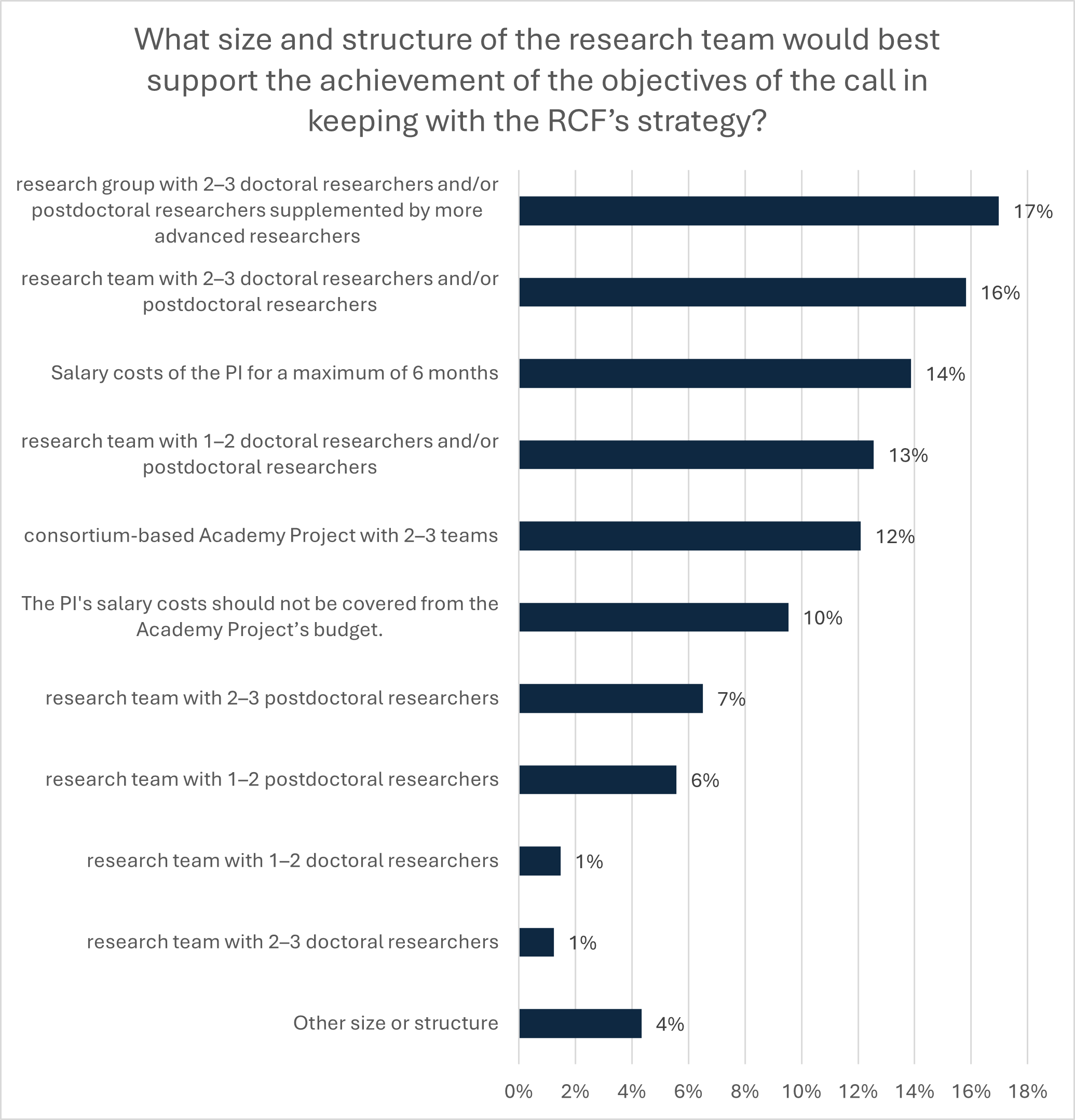
In particular, in biosciences, health and environmental research, as well as in natural sciences and engineering, respondents saw a need for larger budgets, especially in experimental research. The respondents also considered that the size and structure of the project should be left to be determined by project and the nature of the field. Respondents noted that, due to the variation in overhead costs, there are differences between sites of research in the funding available for the research. Primarily, respondents did not consider it necessary to include the PI’s salary in the project budget. The issue was mainly raised by researchers who did not have a permanent position. In their responses, they felt it important that the PI have real time for research and project management.
Methods and criteria in review of applications
58% of respondents considered the current panel review procedure to be the best method of assessment. A quarter of respondents preferred individual review reports prepared by international experts. Some other review methods were also proposed, such as a two-stage call, a hybrid model combining individual and panel reviews, and the possibility for applicants to respond to reviews (rebuttal). It was suggested that the review process be improved by strengthening the expertise of reviewers. Some respondents proposed ‘funding-by-lottery’ to identify projects to be funded among applicants meeting the threshold criteria.
The most important review criteria according to the respondents were the scientific quality, novelty value and innovation of the application; the second most important was the feasibility of the research plan, followed by competence and human resources and observations on the societal effects and impact of the project. Some respondents called for stronger attention to the applicant’s previous merits and the achievements of the research team. In addition, respondents felt that scientific quality, innovation and novelty value, which are currently bundled together, should be separated into their own criteria. The assessment of societal impact was considered problematic and speculative.
Comments were also made about the review process, suggesting that genuinely bold projects were perceived to fare less well. Some felt that the reviewers’ expertise was not always sufficient to identify innovativeness, others criticised excessive requirements for preliminary results. Some respondents also felt that the review of theoretical and conceptual work was problematic. Respondents also saw room for improvement in the review of multidisciplinary applications.
Work continues
The reforms concerning the Academy Project funding scheme are expected to enter into force in several stages in connection with the 2027 and 2028 winter calls. We will provide more information on the changes and their timing in June.

